Entropy-Mess vs. Genesis-Mess:
A New Way of Seeing U.S. Politics in 2026

by R.A. Modro
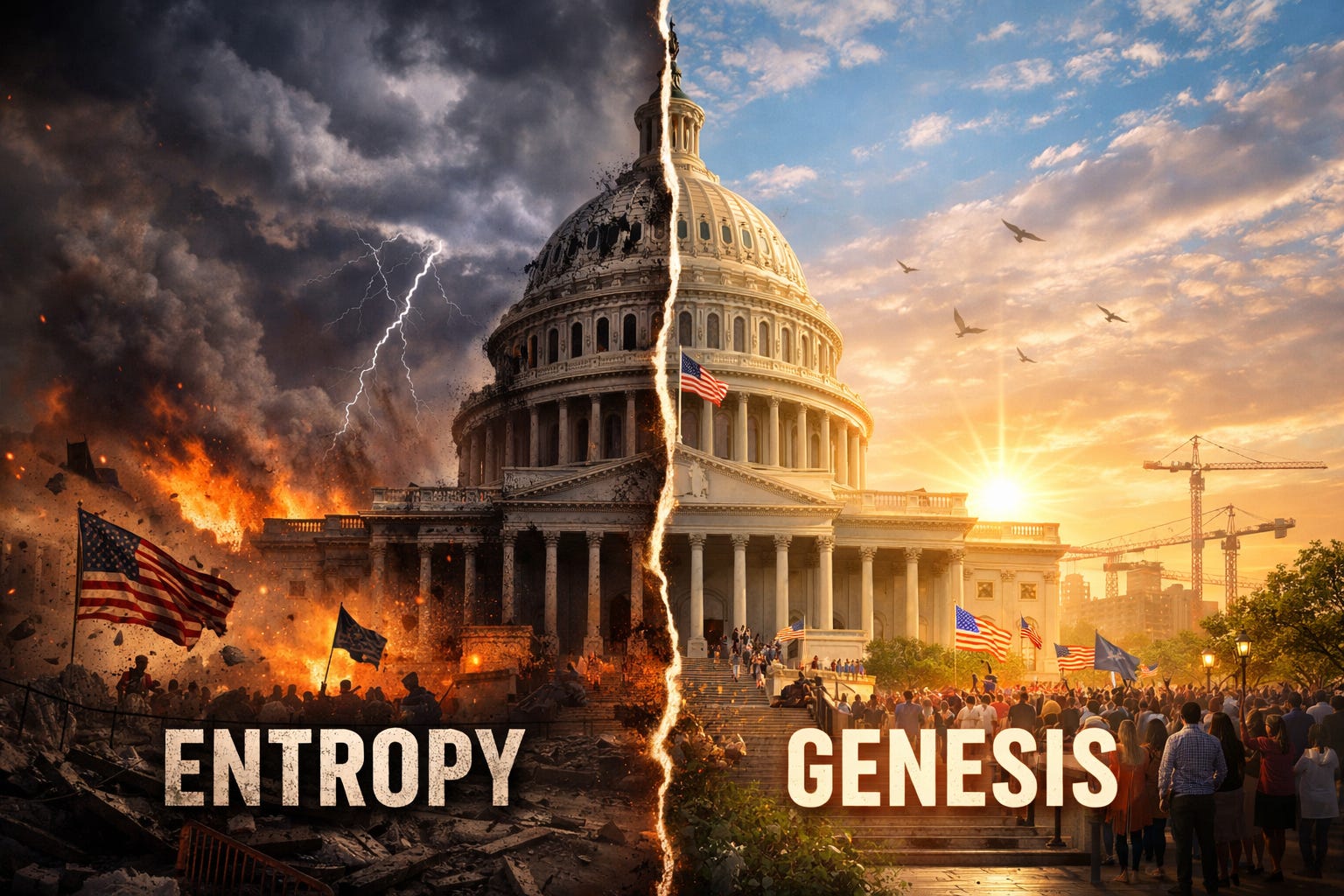
In the midst of the polarized, fractured, and often bewildering landscape of American politics, conventional language, “chaos,” “gridlock,” “conflict,” feels inadequate. It describes what’s happening but doesn’t illuminate why it feels so disorienting and yet strangely generative.
To see deeper, we can borrow a concept from the creative mind: the difference between entropy-mess and genesis-mess. Both look messy. Both feel unsettled. But they emerge from very different dynamics and presage very different futures.
What Is Entropy-Mess?
Entropy is a term from physics that describes the natural drift toward disorder and dissipation of energy. In human systems, entropy-mess looks like:
Fragmentation without coherence
Confusion without direction
Conflict without synthesis
Inertia despite urgency
Redundancy, contradiction, and repeat failures
Entropy-mess is what we feel in politics when every fight seems pointless, every institution appears weakened, and every attempt at progress dissolves into recrimination.
In the U.S. right now, entropy-mess shows up as:
Polarization that shrinks overlap between political communities
Institutional mistrust across ideological lines
Messaging wars that prioritize winning over resolution
Reactive governance instead of proactive vision
The hallmark of entropy-mess is noise without creation. It dissipates energy instead of channeling it. It feels exhausting.
What Is Genesis-Mess?
Genesis, the act of creation, is messy too, but it contains direction and emergence. Genesis-mess is:
Ideas and structures forming before being fully articulated
Tension as precursor to synthesis
Conflict catalyzing new alignments
Breakdown that precedes breakthrough
In individual creativity, we see this in early drafts, scattered notes, recombining themes, and overlapping plot lines before clarity arrives. The chaos isn’t pointless. It’s the field of formation.
Applied to politics, genesis-mess manifests when:
Old frameworks are failing but new frameworks haven’t fully cohered
There’s widespread questioning of assumptions
Competing visions are actively being forged
Public and political actors are reimagining civic meaning
Genesis-mess feels lively, restless, and open — not hopeless.
Is the U.S. in Entropy-Mess or Genesis-Mess?
The short answer: both.
Like a crowded improvisational jam session, American politics right now is an overlay of:
Entropy-mess in the eroding trust in institutions, the cycle of outrage politics, and the fragmentation of media ecosystems
Genesis-mess in the proliferation of new coalitions, emerging political identities, and debates that are not about defending the status quo
Understanding the difference helps us make sense of the confusion.
Entropy-mess symptoms include:
Government shutdown threats and brinkmanship
Extreme partisanship that blocks compromise
Messaging that amplifies fear without framing solutions
Public fatigue with political “theatrics”
These elements reflect disorder as enduring conflict rather than creative transition.
Genesis-mess symptoms include:
Cross-ideological movements on specific issues (e.g., economic reform, civil liberties, tech regulation)
New political figures and platforms emerging outside traditional party structures
Voters rethinking long-held affiliations
Public imagination being activated around “what could be” instead of just “what can’t be”
Genesis-mess isn’t calm. But it’s energetic with potential.
Why This Matters
If we misinterpret political chaos only as entropy, we see only decline and despair. That perspective leads to resignation and cynicism.
But if we see elements of genesis-mess , emergent ideas seeking form, we can:
Recognize tensions as indicative of transformation
Look for structural realignments instead of only dysfunction
Understand conflict as creative friction when new political ground is being broken
Distinguish between destructive noise and productive dissonance
Genesis-mess doesn’t promise immediate clarity. It promises process. It invites citizens, institutions, and leaders into the practice of collective construction rather than merely defense and reaction.
How to Tell Which You’re Witnessing
Ask these questions:
1. Is the conflict pointing toward new frameworks, or reinforcing old stalemates?
If the arguments are only defending yesterday’s positions, that’s entropy-mess. If they’re testing tomorrow’s, that’s genesis.
2. Is energy dissipating, or is it being redistributed?
Chaos that leaves people drained is entropy. Chaos that fuels new initiatives, alliances, and ideas is genesis.
3. Are people retreating or reimagining?
Retreat is the sign of entropy. Reimagination, even if uncomfortable, is a hallmark of genesis.
Conclusion
The current U.S. political moment is not fully one thing or the other. It’s a hybrid terrain where entropy and genesis are entangled. The task for observers, participants, and citizens is not to wish away the mess but to discern the shape of emergence within it.
Understanding the difference between entropy-mess and genesis-mess doesn’t make politics neat. But it does give us a lens that neither inflates panic nor cloaks fracture in naïve optimism.
It invites us to see:
Some chaos is decay, and some chaos is becoming.